

Psychedelics to Treat Human Disease: Many Targets, Lots of Complexity
By Fred Schwaller | September 25, 2025 | Posted in News
Researchers have created a pharmacological “library” of psychedelic drugs and identified the receptors they activate. The new resource could aid the development of safer and more effective compounds, including for headache disorders.
The evidence is mounting that psychedelics like psilocybin, the psychoactive ingredient in magic mushrooms, could be an effective treatment for headache disorders. For example, a small, double-blind, placebo-controlled, exploratory study showed that even a single dose of psilocybin reduced the frequency of migraine headache at two weeks after drug administration. Likewise, a cross-sectional study published this year found that people who took psychedelics at some point in their lives had 25% lower odds of having frequent bad headaches. And two previous studies (see here and here) have reported promising results of psilocybin to treat cluster headache (see MSC related news article).
However, headache researchers still have much work to do to prove that psychedelics will be a viable treatment for headache disorders. One hindrance is that psychedelics have extremely complex effects on the brain, and researchers don’t yet know precisely how they work. That makes it difficult for investigators to predict efficacy and safety of these drugs.
But now, a new study has characterized the pharmacology of psychedelics, showing the complexity of the interactions they have with their molecular targets, and has provided a tool for drug design in the process.
Researchers led by Bryan Roth at the University of North Carolina at Chapel Hill, US, created a “library” of 41 classic psychedelics, and showed the receptors to which they bind, including hundreds of receptors called G protein-coupled receptors (GPCRs). The study found that these psychedelics acted in a “promiscuous” fashion, being capable of activating many different GPCRs, including nearly every serotonin, dopamine, and alpha-adrenergic receptor.
“This is a super useful resource as it will not only help to explain some of the complex and distinct pharmacological properties of different psychedelics, but potentially also help to select specific psychedelics for distinct diseases. It also provides a blueprint for which signaling pathways and targets should be tested in physiological models,” said Daniel Wacker in an email to Migraine Science Collaborative. Wacker is a structural pharmacologist at Icahn School of Medicine at Mount Sinai, New York, US, but was not involved with the new work.
The study appeared as a NeuroResource on July 18, 2025, in the journal Neuron.
A library of psychedelic drugs
The psychopharmacology of psychedelics is as complex as their effects on human consciousness. But “there have been few concerted efforts to characterize these compounds as an entire class,” the authors wrote in their paper.
One big unknown is exactly how psychedelics may be helpful for conditions like migraine.
“Clinical trials show one or two doses of psychedelic drugs can be effective at alleviating migraine and cluster headache. Although psychedelics exert their effect by activating 5HT2A serotonin receptors, there’s no clearcut mechanism explaining how these molecules alleviate cluster headache and migraine,” according to study first author Manish Jain, University of North Carolina at Chapel Hill, US, in an interview with MSC.
So the team created a library of known psychoactive compounds. Using online databases, they identified 255 compounds with reported psychedelic drug-like actions in people.
“We classified these molecules based on their chemical class, and then analyzed their similarity score. This identified 31 molecules that are completely different from each other,” said Jain.
The investigators then added 10 more important analogs from two psychedelic classes, bringing the total to 41 compounds in the final library.
“We provide a dataset of different psychedelics, covering different classes. People can take this dataset and study the signaling effects of the molecules. Most researchers focus on LSD, but there are more psychedelic molecules that may have interesting therapeutic effects,” Jain said.
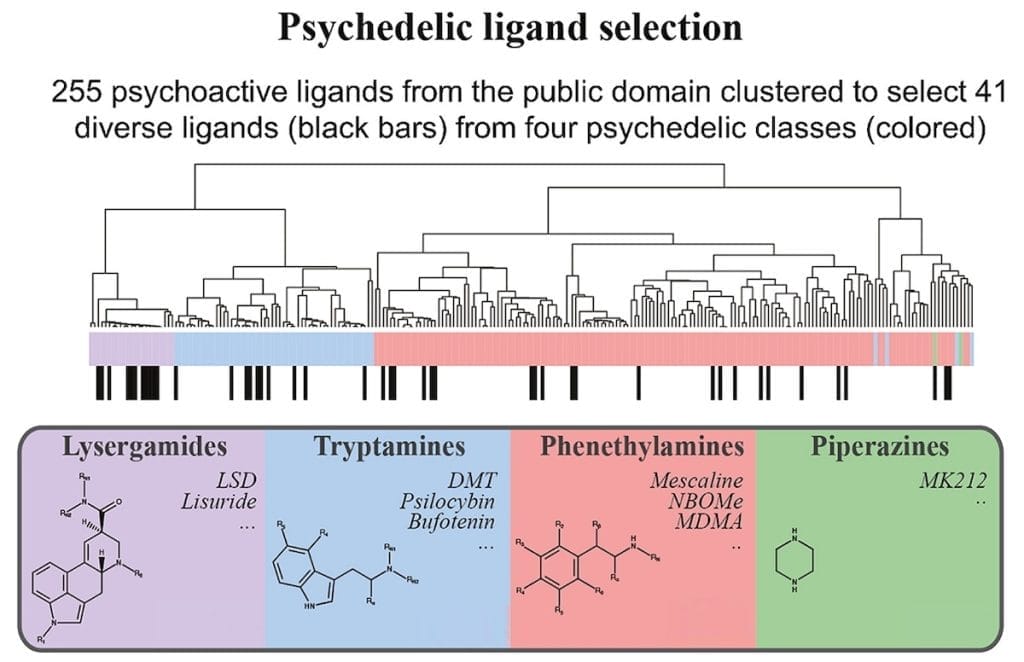
A total of 259 compounds were examined, comprising 255 structurally diverse psychoactive compounds and three endogenous ligands (5-HT, dopamine, and epinephrine), and isoproterenol, utilized in various GPCR functional assays. These compounds were classified broadly into four distinct structural classes: phenethylamines, tryptamines, lysergamides, and piperazines. 41 compounds were selected for study based on their representation within these structural clusters. Image caption and credit: The polypharmacology of psychedelics reveals multiple targets for potential therapeutics. Jain et al. Neuron. 2025 Jul 15:S0896-6273(25)00470-2.
Which molecules do psychedelic drugs act on?
The authors then aimed to uncover the biological targets of each of the psychedelic compounds. They predicted that these drugs would display a promiscuous pharmacology, activating many different types of cell-surface receptors.
The researchers tested their prediction by expressing 318 different GPCRs in a human cell line and then studying which GPCRs each of the 41 different psychedelic molecules activated. They focused on GPCRs because evidence already showed that psychedelics primarily activate 5-HT2A receptors in the brain. These receptors are GPCRs, and they bind the neurotransmitter serotonin.
The results showed that the psychedelics activated a wide variety of GPCRs, which the researchers called a “complex polypharmacology” in their paper. Each psychedelic had a slightly different polypharmacology, but the collection of psychedelics in the library activated almost every member of the 5-HT, dopamine, and alpha-2 adrenergic receptor families. All the psychedelic compounds predominantly activated 5-HT2 receptors, which included 5-HT2A and 5-HT2B receptor subtypes.
Some compounds also activated other GPCRs, including histamine, melatonin, and opioid receptors. Lysergamides, a class of psychedelics that includes LSD, were the most promiscuous, activating an average of 21 targets. Another set of experiments in mice showed that activation of 5-HT2A receptors in response to psychedelics correlated with the head-twitch response, a type of behavioral response where the animals rotate their head from side to side. That boosted the evidence for a role of those receptors in psychedelic effects.
“The data provide some glimpse into the receptor-specific signaling pathways psychedelics engage, providing hypotheses as to which signaling pathways might be critical in the treatment of distinct diseases,” Wacker said.
However, he added that findings from the in vitro system the researchers used to assess the pharmacological properties of psychedelics don’t necessarily translate to how these drugs work in the brain.
“It can be difficult to extrapolate from the current findings what the ultimate effect in a neuronal context and certainly behavioral context is,” he said.
The results also provide hints at why some psychedelic drugs have hallucinogenic properties while others don’t. By comparing the receptor targets of these drugs, the researchers found that hallucinogenic psychedelics, like LSD, interacted with more receptor pathways than their non-hallucinogenic analogs, like lisuride (an LSD analog).
Jain said these results are important because studies have shown mixed results on whether the hallucinogenic properties of psychedelics are necessary to treat disease.
“It’s possible that psychoactive properties of these drugs are important for their therapeutic effect,” he said.
But it’s been difficult to know for sure, since it’s challenging to separate the hallucinogenic versus non-hallucinogenic properties of the drugs in the brain, he added.
Designing better psychedelic therapies for migraine
With the new psychedelic drug library, along with discovery of the drugs’ receptor activation profiles, drug designers may be able to design better psychedelics – ones that have more specific therapeutic effects, and fewer side effects, the authors said.
“This dataset provides a number of interesting molecules to look into for treatment of different neuropsychological disorders. [Drug developers] can look at detailed signaling of psychedelic molecules. For example, psychedelic drugs activating dopamine receptors might alter mood more than others. It depends on what properties they want; they can design the molecules to address those needs, and help identify possible side effects of psychedelics,” said Jain.
For example, classical psychedelics like LSD activate 5-HT2B receptors in the heart, and studies have linked chronic microdosing of psychedelics with cardiac valvulopathy. The new study found that all the psychedelics tested by the researchers activated those receptors.
“We could design better molecules to avoid this side effect,” said Jain.
Wacker pointed to the study’s characterization not only of the GPCR targets of psychedelics, but also of interactions with kinases, which are enzymes that add phosphate groups to molecules. In particular, LSD did not have potent interactions with any of the 450 kinases they examined, including a kinase called TrkB, which had previously been linked to LSD’s mechanism of action.
But the study’s main focus was on the GPCRs, and, according to Wacker, that work “opens a door to reverse engineer the system, and, knowing that psychedelics alleviate migraine and headaches, figure out which pathways and receptors are critical for these therapeutic effects.”
Wacker said that understanding the molecular targets that different psychedelics engage would help scientists select suitable compounds, or even develop novel compounds, for headache disorders.
“For instance, while 5-HT2A appears to mediate much of the therapeutic effect not just in depression but also in migraine and headache treatment, other receptors might be critical as well. In fact, activation of 5-HT1F [using lasmiditan] or 5-HT1B and 5-HT1D [via triptans] is clinically used as abortive treatments of acute episodes of migraine,” he said.
Jain added that there are still barriers to selecting specific psychedelic drugs to treat certain diseases. That’s because scientists don’t fully understand how psychedelic drugs work in the brain. And it’s possible that migraine might involve different signaling cascades compared to other diseases like depression.
“We need to study a lot more how these psychedelic drugs exert their effects, like studying their downstream effects on signaling pathways and epigenetic changes. And then we also need to study the neurophysiological mechanisms, such as investigating how psychedelics alter neuronal circuitry in the brain. Our study provides a resource for researchers to do this,” said Jain.
Fred Schwaller, PhD, is a freelance science writer based in Germany.
Reference
The polypharmacology of psychedelics reveals multiple targets for potential therapeutics.
Jain et al.
Neuron. 2025 Jul 18:S0896-6273(25)00470-2. Online ahead of print.
Image credit: ID 380770505 © Skypixel | Dreamstime.com

This work is licensed under a Creative Commons Attribution-NonCommercial-NoDerivatives 4.0 International License.
Sign Up For An MSC Newsletter
Share this article:

Discussion
Search
Recent News
Recent Papers
Calendar
7th Annual Great Lakes Regional Headache Society Meeting
Sheraton Pittsburgh Hotel at Station Square, Pittsburgh, US